Showing posts with label hunting blind. Show all posts

Wednesday, January 15

Opening Day of Goose Season 2013


Brushed and Ready for Opening Day

  Gear stacked up on the first floor ready to put in the car, we sat before dawn in silence eating breakfast, watching the minutes tick away as we waited to leave. It was opening day of goose season 2013. Not unlike Christmas, you end up waking up every half hour waiting for the alarm to go off triggering next season's escapades. We were invited by John to shoot the piano blind we helped build about a month before and highlighted in a previous post. The blind was well brushed with cedar and bayberry over the roof.

  As we drove across the field with the decoys in the utility trailer behind us, it came into view. Today, there would be ten of us hunting two different blinds: five in the new blind and the others in a blind build decades before, of the same construction. It was in an adjoining field and the blinds were at 90 degree angles to one another, so there was no chance of a sudden shower of steel from an errant shot.

  The ~ four dozen decoys in a open pattern of "pods" allowed a nice landing zone. It was warm, 48 degrees, and wet and we dressed for it. Cloudy overnight, it had been close to a full moon the last few days and I was hoping that the geese had not fed under the fall moon. We set up and waited. Before long, the sound of birds behind us filled the air and many were passing between two bodies of water, as we were on a peninsula.  They did not seem to be hungry and were just buzzing by and checking out the action on the ground. There were only two or three sets that circled,  out of close to two dozen flights of birds, which seemed to us that they were not interested in food.

  Early in the season and with the warm weather, there was no reason to fatten up for the cold of winter. As the morning went on, I stepped out of the blind to see if there was any items that were catching their attention and making them flare. We caught up on conversation as the geese did fly-bys just out of range. I enjoyed having the Wildfowl Ninja in my blind, who was picking up sage advice from the group of seasoned hunters.

The Wildfowl Ninja Casts a Knowing Look


 As we called, a pair appeared and passed behind us and drifted in quick off the left side of the blind, silently gliding. They locked up their wings and we let the youngest in the group get ready (reference picture above), and as the two passed our blind about 25 yards out, the shells started ejecting. The lead bird on the right crumpled and spun into the ground. The second bird turned back to the left and before he could gain altitude, he was hit and fell into our decoys. Loping out into the field, Tucker, a beautiful Weimaraner, collected the birds and brought them back with a spring in his step.


Tucker in His Element


As the morning progressed, we dined on incredible smoked goose on a fresh slice of sourdough, as well as fresh figs. We also had to have the requisite ESO Opening Day delight, the venerable Pop-Tart.


Smoked Goose on Sourdough and Hevi-Shot: a Deadly Combination


Later, another flight landed at the edge of decoys, near the range decoy but were too far out for a good kill shot. Approaching noon, the realization that the geese weren't committing set in and we packed up our decoys.

Packing up the Dekes


 At which point, the skies are crowded with birds in passing range. It always happens.

  I breasted, brined and marinaded the goose breasts. It was a good start to the season: I didn't forget anything for the field; decoys were in great shape, and we were successful in bringing birds to our spreads.

  It dawned on me that there was a shift in my definition of a successful hunt. There is as much to gain from the experience and collective wisdom in the blind, as there is from shooting out of it.

  Do I have to fill the pot to bring home what I need?

Monday, November 4

The Third Time's A Charm


Where's Waldo? 


    “Do you have a yardstick?” I asked the young man behind the counter, as I look at the bolt of Wetlands camo burlap five feet tall.  He apologized for it not being out, explaining that he had just started at the hunting and fishing store on MD Route 50, a few miles from the Bay Bridge, gateway to the Eastern Shore. This must be an after school gig, I figured, as I eyed the cherubic lad. 

As he measured, I commented that a yard was 36” and not the 48” he had in hand. “Oh yeah, that’s right”, he responded, as he shortened his measurement. As we finished up, he tugged more off the bolt. “Here is some extra, in case you need it”, he said, as he scissored the coarse cloth.


As the Wildfowl Ninja and I carried all of our supplies across the field yesterday, I was pleased that the overnight rain had softened the ground, to provide advantage in pounding the metal stakes a foot into the ground. Our project was simple: build a screen blind for hunting geese in a plowed corn field. 

As we trudged across the field and the Ninja fell behind under the weight of the mason’s bag filled with hand sledge, a kukri and assorted hand tools, I continued my diatribe. “The first time you do something it takes three times longer; the second time twice as long , and the third time is a slam dunk”, I offered, repeating the phrase a colleague had made, while I was working at a global consulting firm. 

And this was our third screen blind, having built two last year on this property.


Insta-Blind: Just Add Elbow Grease!


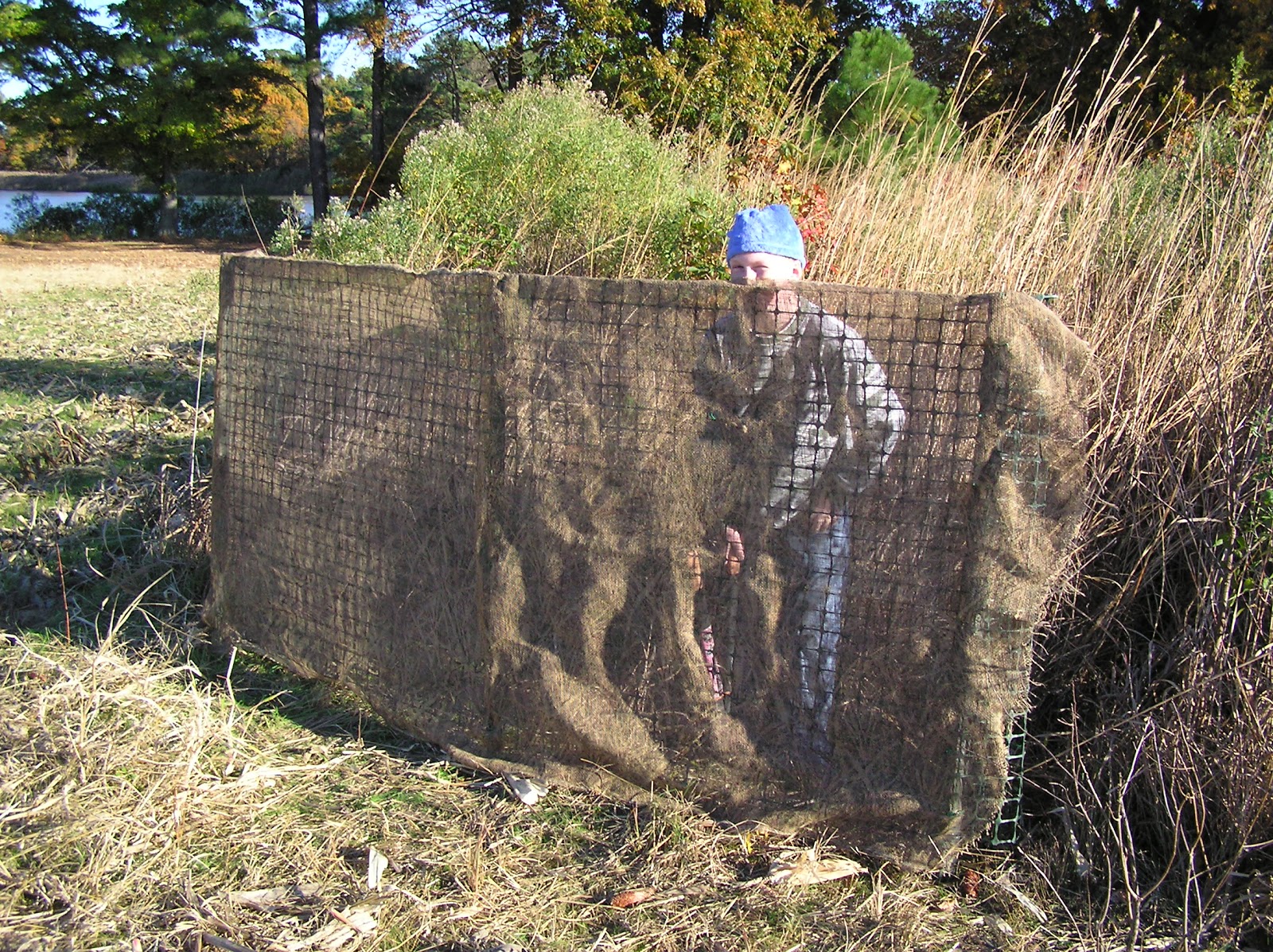
Using three six foot metal fence stakes, 48” green vinyl perimeter fencing and camo burlap, we decided to set the blind on the edge of a plowed corn field. With our backs in a growth of tall grasses and small bushes, the blind would be facing north, and in front of us would be ample room to set up decoy spread scenarios.
All of our materials and tools at the ready, I measured the blind length.  We decided on close to eight feet, with it slightly convex at the center stake. In preparation, I had painted the stakes with three coats of Rust-Oleum Camouflage flat green and then another coat of alternating stripes of flat tan.  After pounding in the stakes, which came out to be ~53” high, I laid out the green fencing.


Slowly Taking Shape


Stretching the fencing, I used zip ties to attach about every 8” vertically along the stake, working from left to right. After completed, I allowed some fencing to overlap about 8” on either side, in case I wanted to add burlap to the sides at a later date. Finally, the Wildfowl Ninja snipped off the extra from each locked zip tie.


Center Post and Fencing Up - Bring On the Burlap!


With the camo burlap laying over the blind, I checked to see is there was a top/bottom to the pattern, and then I laid about 4” over the top of the blind and working right to left zip tied the burlap to the fencing. I attached the burlap to each stake and lightly stretched it across to the next and tied it at the same intervals as the fencing. My partner worked diligently smoothing out the burlap and keeping the flow of zip ties coming. We finished it off, by doubling it over the top and tying it through the fencing and both sides of fabric. This step visually “softened” the top edge of the blind.


Wildfowl Ninja Checks For Level


As we always aim to better the construction, we improved on our brushing technique this year. Last year, we had tied decoy cord across the stakes, to tuck grasses and flora against the front of the blind. It worked well, but between hunts, the cord would stretch under weather effects and we would re-tighten every time in the blind (and also re-brush, which is Standard Operating Practice to keep us hidden). 

This year, I decided to add a doubled over bungee cord to one side and passed it through a looped piece of camo paracord. When it loosened under strain, I could tie another loop essentially tightening the “brush cord”. Also, although the heavier paracord would stretch, it was stronger than the decoy line. There was one “brush cord” at 18” off the ground and another 12” from the top of the blind. Last year, I only used one.


Bungee Detail: Patent Pending

With the bungee in place, I now walked far off from the blind site and cut the grasses with the kukri. The kukri is a long handled machete popular in India and was used by the Ghurkas in WWII. It is very effective at cutting grasses, small saplings, as its wide blade allows good purchase on what you are cutting. Mine is made by Cold Steel and keeps a good edge and is easy to sharpen. 

Passing grass to my partner, he tucked in the grasses and continued further concealment efforts. We finished the brushing (though we need to add more) with small bushes on the end stakes.

Primary Brushing in Place


Pre Hot Plate Installation


The Land Of Pleasant Living


As we cleaned up the blind site and added final touches of brush, I guess that young man at the shop was right. I did need that extra burlap he measured for me. He may have been new to the shop, but was not new to building a blind.

Monday, October 21

Building an Eastern Shore Blind


A Fine Day's Work


  That is what a work day is like, I told the Wildfowl Ninja, as we drove down the lane toward home.  We started at 8:30, I recapped, broke for lunch, wrapped up close to 6 and had a lot to show for our hard work. He was the youngest on the crew by three decades, but handled himself like an eager apprentice: ready for grunt work, did not complain or horse around.

  With a load from the lumber yard delivered, and the plans taped to the back wall of the garage, I let the men with true construction knowledge lead the way.  I do not consider being able to plane a door or fix a broken toilet as adequate to lead the charge on such an important project. Among the seven of us, we had decades of blind building experience, deep construction skill sets, strong backs and good attitudes.

   The task was straight forward: build a blind 12' by 5' with 5' foot back wall and 4’ front and side walls. 32” wide door in the back wall offset to the left, with a 16" wide seat across and a removable seat at the door. The roof would be pitched at a ~30 degree angle, allowing the shooter to stand up and out with clear shooting lanes. Set on cinder blocks and facing southeast, the blind was in a mowed corn field.

  Under an overcast sky we got to work on the floor of ¾” pressure treated plywood with 2x8 joists. The Wildfowl Ninja was eager to help with measuring the pieces needed, but particularly excited to get trained on the nail gun and used it in finishing the floor. Radiant heating tiles in Mossy Oak ShadowGrass Blades will be installed after a base coat of Old Goose paint.


The Wildfowl Ninja Mans the Gun


  With the depth of construction knowledge there were not many re-do’s, and “Measure Twice, Cut Once” was the unspoken rule. As Always. With one team measuring and cutting and another constructing and nailing, we made short work of the rest of this modular blind. The floor became the template on which to build the front and back walls, with shell shelves on the front wall and a door in the back wall. The side walls were constructed to fit inside the front and back walls, with plywood overlapping to screw into the ends of the front and back walls. Well thought out and built to withstand years of searing summers and cold wet winters, this was shaping up to be a beast.


Modular Blind Building


  The lunch bell rang and we were treated to a fantastic lunch of salad, fresh warm homemade bread and stew. Filled with pearl onions, peas, carrot, potatoes and tender chunks of goose breast, this was possibly one of the best stews I have had. The combination of the vegetables bathed in a thick broth and soft chunks of goose combined for a perfect blend and balance for the epitome of what a stew should provide: a foundation of hearty protein and vegetable vitamins. I almost went for a third helping, but there was work to be done.

  With all the pieces sideways on a utility trailer, the blind was hauled out to the nearby field. The back wall was carried off the trailer and placed behind the blind foundation, as we readied the floor for positioning.


The Floor is Ready for Placement


  The blind site was relatively level and blocks had been put in place for a foundation, so there would be a little bit of block overhang. The blind would be set in up against a few trees and some scrub, so in a few years, the growth would wrap around and contribute to the stealth of the blind.


Grading the Foundation

Two Up; Two to Go!


  With the sides up, the next conundrum was to ensure that the pitch of the roof was enough to provide cover from rain, concealment from birds, but not hinder the hunter’s ability to rise, move forward, mount and shoot. After some discussion, the pitch was determined and the 12’ roof by built with a 2x8 running lengthwise providing lateral support and a middle angled piece to keep the roof from bowing over time. Additionally, solar panels will provide enough energy for the early warning MigRadar (Migratory Radar System)


Door Detail with the Roof  in the Works

Roof Up and Benches Next


  Roof set, the bench was then made on a 2x4 frame, 16’ off the floor and 16” wide. It was determined that there would be a removable seat where the door was located. The rich Corinthian leather would be added once it was Scotch Guarded, (or Schnapps Guarded, pick your poison)


Bench in Place, with Shell Shelfs at the Ready

Bench with Door Closed 


  All put together and with extra screws for good measure, this juggernaut will provide cover from the elements for seasons to come. If it would only help my crossing shot. That comes with experience. This building project provided the Wildfowl Ninja with the experience of working with capable men to build a super solid hunting platform from a pile of lumber and hand drawn plans. He thought that was cool. The same cool that comes from being outdoors in a light rain on a cool day working hard.


Just add Paint and Brush...and Geese!